
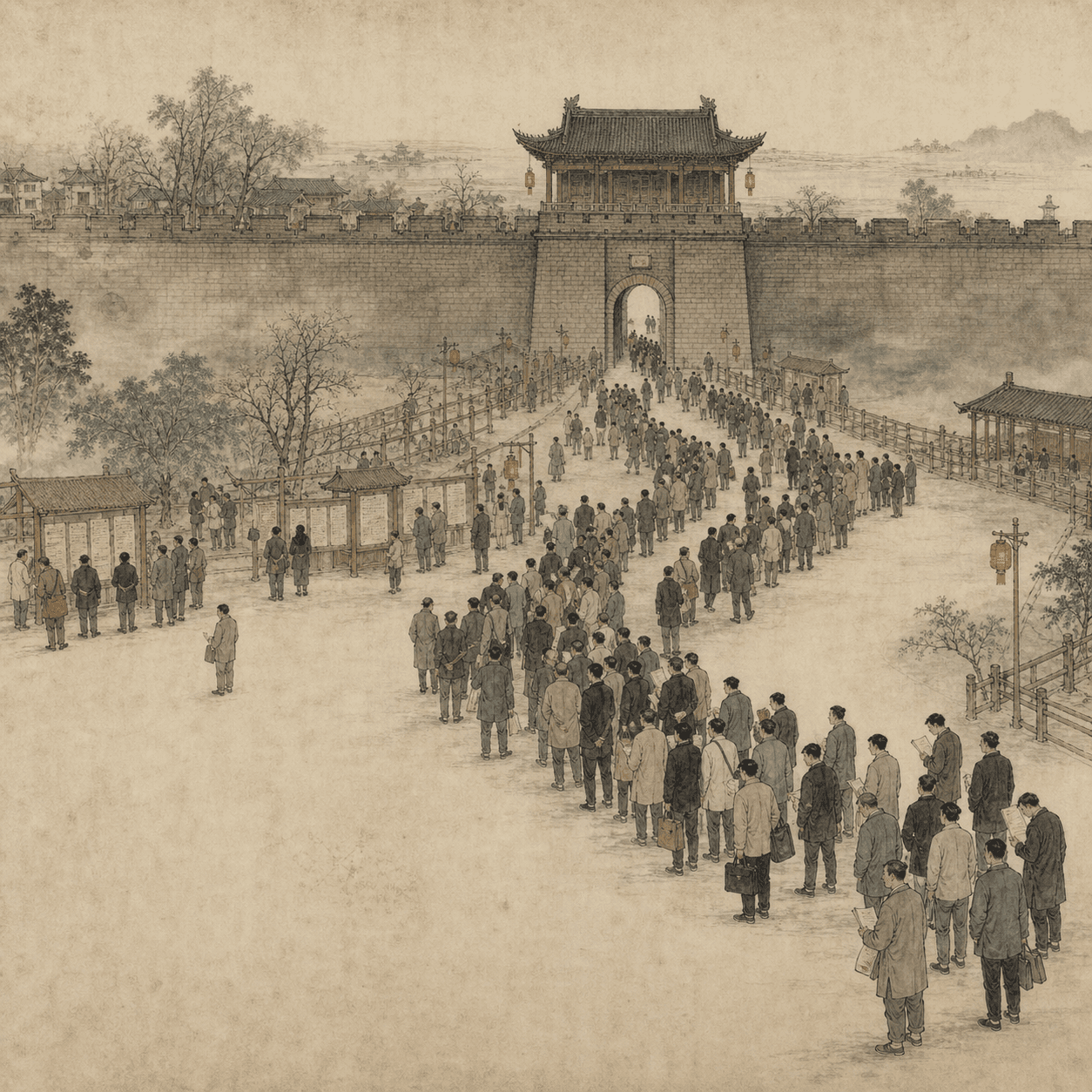
Truth about employment
A candid reflection on layoffs, job hunting, and accepting how hard the employee path can be.
Getting lost in the job market
This is not career advice. It is just what I have been through.
For the past year, finding a job has not gone well for me. My portfolio was not good enough. It lacked a lot of the fancy stuff. My experience was not specialized enough, and I did not have the kind of research-heavy design work people want to see. After ten years in design, I finally had to admit something very clearly: in this industry, I am a very, very ordinary person.
Having worked at a big tech company did not mean my design skills were actually good enough for that job. I got in during the period when every tech company was hiring like crazy. Based on my actual ability, I probably would have had a hard time getting into a company like that otherwise. As a Christian, I also believe God allowed me to be there.
I once had a great job. That did not mean I had the ability to match it. Then I got laid off, right when large companies and tech companies were cutting people aggressively: cleaning up the hiring spree from the pandemic while dealing with the market swings that came with the Fed raising rates. The path that once looked stable suddenly was not stable at all.
The struggle after getting laid off
Right after I was laid off, I worked hard on my portfolio. I looked at a lot of work from designers I admired, rewrote every story again and again, made things sound better than they were, and added things I had never actually done. I practiced interviewing by talking to the air. In interviews, I smiled at everyone, flattered people, and made myself as small as possible.
When I ran into an interviewer who was trying to make things difficult, I would leave angry and sad. As a father of two, that was the first time I really felt that kind of powerlessness: not everything can be fixed by trying harder. Sometimes no is just no. You do not get there overnight, and there is no such thing as “if only I had known.” Life does not give you that. What happens becomes part of the lesson.
After six months without work, I took a job at a company a friend recommended so I could support my family. My title became Graphic Designer again, which was also the title of my first job after graduation.
UX design was not even that popular when I first started, and I already hated the title Graphic Designer. Using it again meant letting go of my pride and a lot of things I thought I understood. I worked, learned the business, and kept trying to figure out where I was going in life.
Using AI to do things I could not do before
I started asking myself: should I give up design?
I could not compete with the big-tech designers. My experience was not even enough to get my foot in the door, much less give me work that could survive an interview. At that time, I went to work every day like a zombie. I did things I did not like and thought about a future with no clear direction.
But the way we worked had changed. I became the only person at my company who started using Codex to get things done. Very quickly, I was building Shopify Liquid themes, then Shopify apps, even though I had known nothing about either before. It took me only a few months to go from zero to feeling confident that I could build a theme on my own.
Once I experienced the speed AI gave me, and felt some of those knowledge barriers start to disappear, I decided to try finding a design job one more time.
First, I stopped sending out resumes. In the scraps of time around my job, I built my own portfolio site with Next.js. I even built the prototype for one project directly in React. I moved my old work onto the new site and rewrote everything to be honest. No lies.
Then I started my first real AI-assisted coding project. Why build something new? Because my past failures had taught me this: my old work and experience were not going to get me where I wanted to go. You can package mediocre work however you want. It is still mediocre.
Using Codex, I designed and built a job-search platform. I bought a domain and paid for database services. It was a web app where people could sign up, log in, and connect to a backend database. I also made a web presentation for it because I had planned to show it in interviews.
In the end, I shelved the project. I only planned to show it in a relevant second-round interview, if one ever happened. The database, authentication service, and hosting all cost money, so I never promoted it. It took me about six months from start to finish. I did build an app, but the time cost was real.
Six months after rebuilding my portfolio, I tried again
I started applying again. This time, I had a new portfolio site that I had built myself in React. Everything in it was real, and I had this new project as an opening hook.
Still, I got very few interviews. I started wondering whether it was because it was the middle of the year. Or was it the same old problem: was my portfolio still not good enough? Or were designers now just too good, too good at packaging themselves and their work?
Eventually, I started taking the whole job-search thing less seriously. Finding a job, getting through interviews, and doing the work after you are hired each form a triangle. For every triangle, you probably need at least one strong side to have a chance. Two makes your chances better.
The truth is, working for someone else is hard
The first triangle: what it takes to get a job
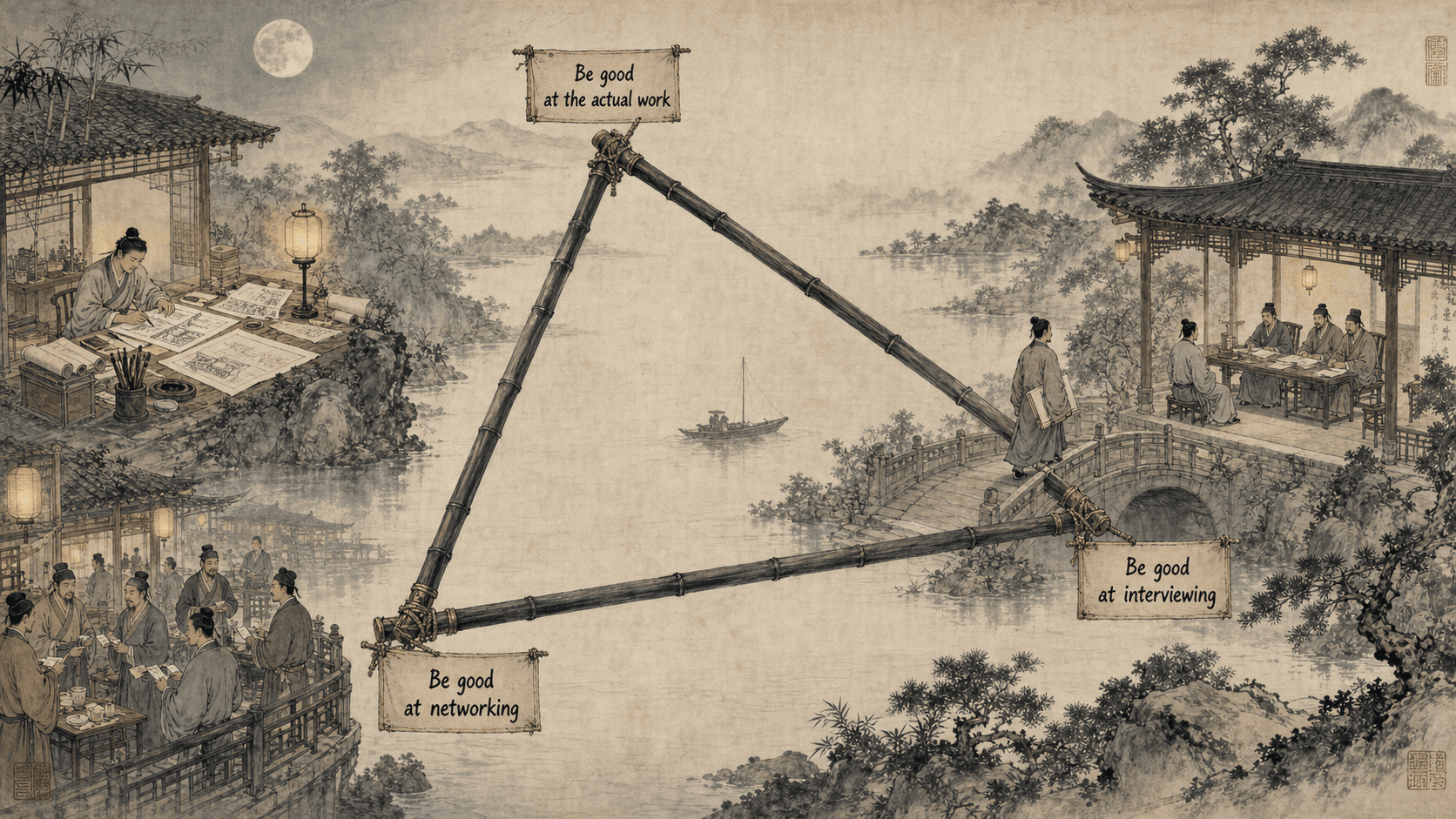
Be good at the actual work
In design, you can usually see whether someone is good from their past work. Visual quality, logic, and creativity all show up in a portfolio eventually.
But getting to that level means being a real design talent. I mean someone who naturally has good visual taste, strong logical thinking, the ability to learn, process a lot of information, and use the tools. Now you have to add AI skills to that list too. These are hard skills, and it is not easy for an ordinary person to have all of them.
Be good at interviewing
Interviewing comes down to how quickly you can think: how fast you can pull together your experience and information, and how well you can put it into words. Can you quickly explain why you are right for the role?
Memory matters too. If you forget the material and interview questions you prepared for, or freeze up, your words will not keep up.
There is another skill too: a talent for lying. People who can make up stories and polish them are genuinely better at interviews. People who are great at interviewing probably also have some mid-sized or big-company names on their resumes, because they got through those extremely complicated interview loops.
Be good at networking
This is about whether you are willing to go to a lot of networking events. Extroverts are not usually afraid of socializing, and it does not drain as much of their energy. They can introduce themselves quickly and make people remember them.
That takes emotional intelligence and a feel for language. At work, these are also the people their managers want to bring with them to the next company.
None of these things are easy. Some people do not naturally have even one of them, because a lot of us are just ordinary, mediocre people.
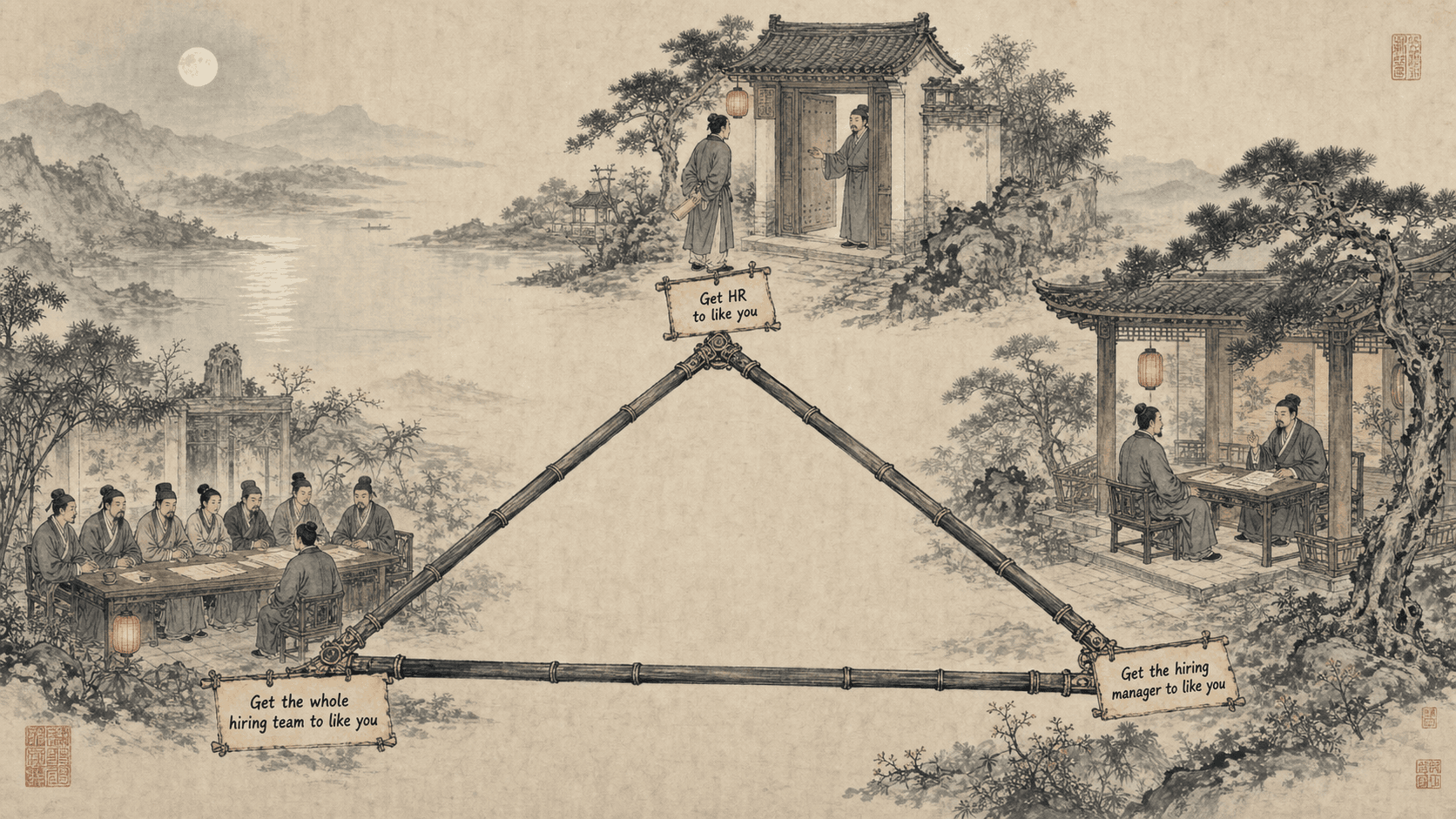
If you do not have any of the three, job hunting becomes a matter of applying over and over, trying to get HR, the hiring manager, and your potential coworkers to believe in you. Then you enter the next loop: the interview triangle.
The second triangle: getting through the interview
Whether or not you have one standout strength, job hunting is a numbers game. If you do not have deep experience shipping work or a big-company name on your resume, applying again and again is like trying to shoot a BB through a hole that is about the same size as the BB. Whether it goes in is basically mysticism.
Get HR to like you
The first interview is about explaining your experience to someone who may not have much professional context for it. You need to explain it in a few sentences, and make HR think you are reliable enough to pass on to the hiring manager—whether they actually understood what you said or not.
It also depends on whether you click. If an HR person likes talking to you, they may be more willing to push for you. If you do not click, they may basically stop caring.
This round looks unimportant, but it is not. It means your resume was at least good enough to get noticed. And if you have a good relationship with HR, they might even give you a few hints for the next round.
Get the hiring manager to like you
This one is very hard. Two things have to happen: you have to click with this person, and they have to believe in your ability.
They are hiring someone to do a specific job. More importantly, your way of working, the way you speak, and your sense of judgment cannot make the manager look bad. You can get along great, but if your ability does not match what they need, they will not pick you.
Get the whole hiring team to like you
You need most of the team to vote for you. Unless the hiring manager has a lot of influence and a high enough title, the people underneath them may not be so forgiving.
Sometimes the hiring manager likes a candidate, but one vote from an engineering manager or product manager changes their mind. If the design team itself has mixed feelings, your odds get worse.
The formal interview process is like making a new friend, then having to become friends with most of the people in their friend group and get their approval too. That is hard. One wrong sentence, one person’s first impression, or any number of personal factors can change the outcome. A lot of it is completely outside your control.
The third triangle: keeping the job
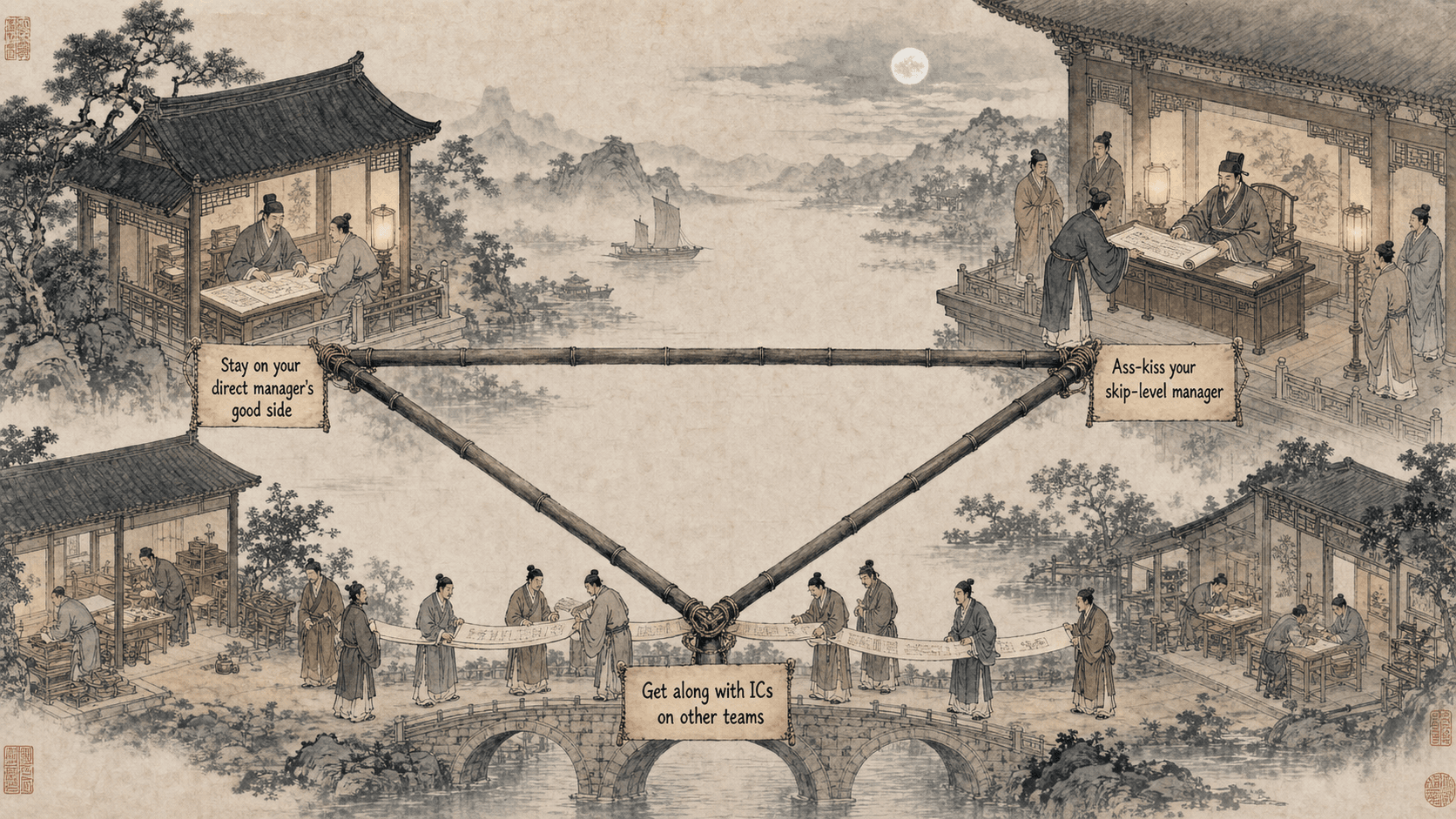
Stay on your direct manager’s good side
This is usually the easiest part, because this person probably believed you could do the job and hired you. The relationship starts out well. Whether it stays that way depends on whether you meet their expectations. That is about your work, but also about emotional intelligence.
When pressure shows up, can you stand on your manager’s side? That is harder than it sounds. I stood firmly with mine. After he got laid off, I was laid off too. But when he went to his next company, I was the first person he thought of.
At the time, I had just become a father for the first time and was too scared to change jobs. So I missed a big opportunity to become a Director of Design. Later, I was laid off, fell back into the job market, and never really climbed out again.
Ass-kiss your skip-level manager
Building a relationship with someone at this level is not easy. First, you cannot let your direct manager think you are going around them. Second, the work you do has to be useful to the skip-level manager indirectly.
For a designer, if you are great at PowerPoint and always available, there is a chance your manager will ask for help. Eventually, they need someone they trust to make presentations that look good, quickly and efficiently.
The advantage of having a relationship with senior leadership is that you may not hear about trouble in advance, but when something really happens, someone might save you.
The first time I went through layoffs, I was already on the list. A VP from another department, someone I would occasionally have meals and conversations with, traded one of her department’s head counts to keep me. That does not happen often. During a broad layoff, department leaders may not have that much control. Still, I believe that having a good relationship with senior leaders is always better than not having one.
Get along with ICs on other teams
If you can get along with individual contributors on other teams, it usually means you know how to move through an organization, you have decent emotional intelligence, and people like you. Some of that is natural. Some of it can be learned.
Being good at your job does not necessarily make people like you. More often, it can make people jealous or hostile. But someone who knows how to talk to people is more likely to get a project across the finish line.
At big companies, cross-team collaboration is often what matters most. Knowing what to say, what to protect, and what to give up is how work gets done. Many projects are not some grand invention. They may be a simple concept or feature. But being good at your own function is not enough. If you cannot get the relevant teams on board, the project will not have a good outcome.
I know this from experience. I once led a big project that was not actually complicated, but involved many teams. I kept running into walls. Different opinions and requests buried me, and eventually I lost the direction.
In a large organization, you suddenly realize that getting one person to accept an idea is difficult. Getting many people to move together is even harder. But that is the game big companies play.
So yes, the employee path is hard
In a job market this competitive, getting into a company that is merely decent is already difficult. Getting into one of the best companies in the world means meeting almost every requirement in all of those triangles.
That is why I no longer apply every day and wait around for an opportunity to appear. After leaving tech and failing to find work for six months, I had to accept something: this job market is even less likely to give someone with a big gap a chance. Companies use relevant experience and big-company names to decide quickly whether you are even worth interviewing. A lot of the time, your resume gets rejected before anyone really sees it.
For one role, people all over the U.S., and even all over India, apply at once. The volume explodes. I have looked through applicants’ resumes from the perspective of an assistant hiring manager. There are too many applicants, and you still have your own work to do. You cannot spend an entire day slowly reviewing every resume and choosing carefully.
On top of that, a lot of portfolios look the same. After a while, your eyes start to blur. You do not even know what you are looking at anymore.
Cannot just sit there and wait

I am not someone who gives up easily. If the job-search path does not work, then I need to find another way: change lanes. I have seen a lot of LinkedIn posts from designers who have been looking for work for years. Some of the people who were laid off with me are still looking too.
Honestly, even if I could go back to one of those big companies, the money is about the only thing I would like about it. Everything else feels like a place where you put on a fake face, kiss ass to survive, and give up control of your time.
If I can start a business, I will start a business. If I need to do freelance work, I will do freelance work. Life is long. A stable job does sound attractive, but when I think about all the time I once spent on meaningless documentation and alignment, it feels like such a waste.
My parents get older every day. My children grow up every day. If I can build something of my own, even if I never make as much money as I did before, maybe having more control over my time is what being clear-eyed about life really means.
This article will probably not have many readers. But if you made it to the end, I hope it helps you a little.