
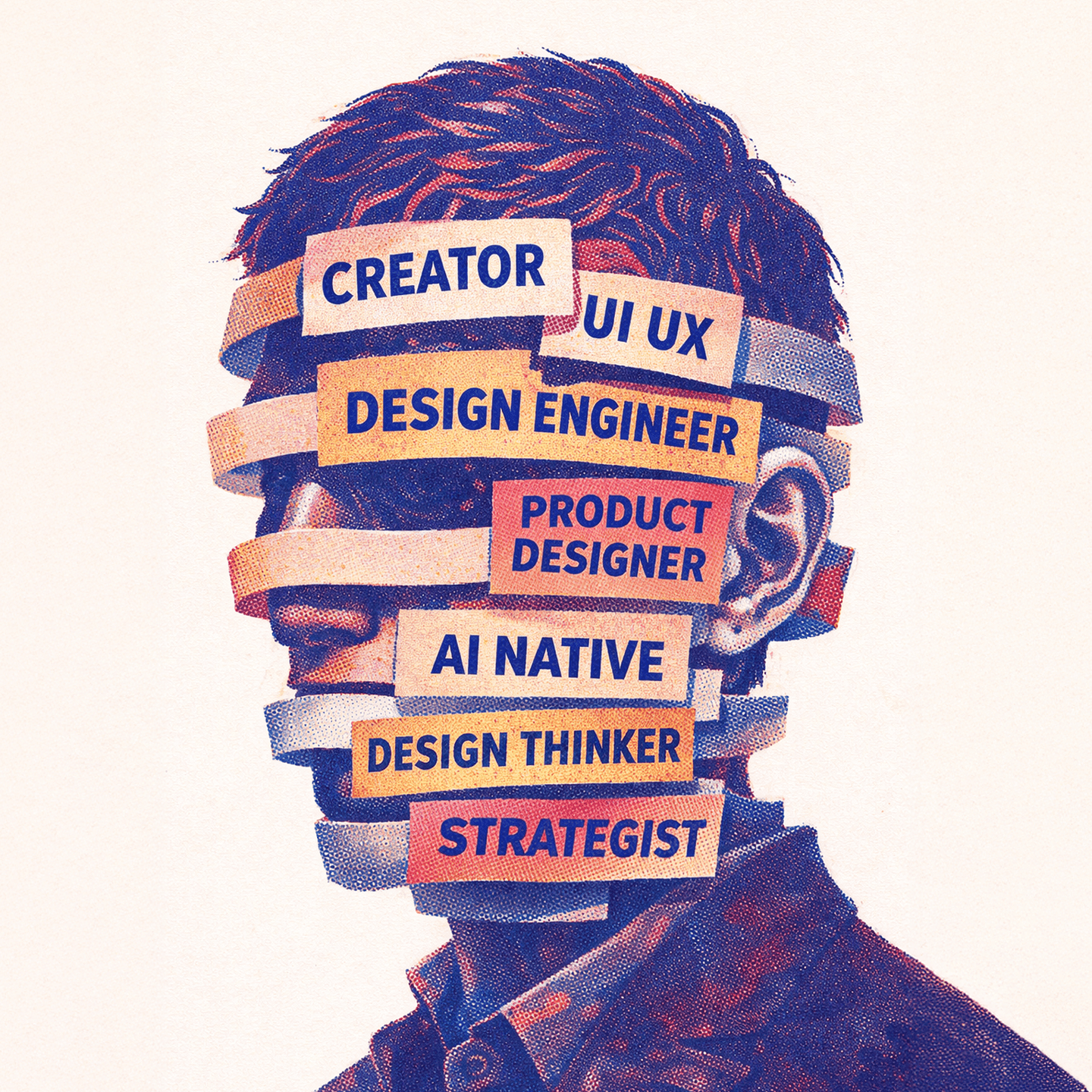
When AI breaks the walls around design
As the boundaries between design, product, and engineering become more porous, titles matter less and execution becomes easier for everyone. What remains difficult, and increasingly valuable, is judgment.
Lately, I have been seeing the same message everywhere: AI can do this, AI can do that, AI is replacing this role, AI is changing that industry.
A lot of it is framed as excitement, but underneath it, it also creates anxiety.
As a designer, I keep coming back to one uncomfortable question:
What is the real value of design to a business, especially now that AI is lowering the barrier to execution for almost everyone?
For a long time, design has lived in an awkward position inside companies. Designers can be paid well, but that has never meant they hold equal power. In most organizations, the strongest voices still belong to engineering, technical leadership, and product strategy. Functionality comes first. User experience comes after. Businesses usually ask, “Can we build it?” before they ask, “Is this the right experience?”
That imbalance is not new. What feels new is that AI is now exposing it more clearly than ever.
Design has been in a constant identity crisis
The design industry has always been asked to evolve.
At first, it was not enough to make things look good. Designers had to think more deeply. Then companies wanted user-centered thinking, so more people became UI/UX designers. Later that was not enough either. Businesses wanted designers who could think about product, business models, trade-offs, and growth, so the title shifted again into product designer.
Now AI has arrived, and the cycle is repeating.
Suddenly the industry is full of new labels: AI-native designer, design engineer, prompt-based creator, and more. Everyone is trying to reposition themselves before the ground moves again.
But the more I watch this happen, the more I feel that titles are not the real story.
Titles are often just our way of defending relevance.
Companies do not care much about what we call ourselves. They care about whether we can create value.
AI is weakening the old boundaries between roles
For years, one of the strongest boundaries in tech was technical skill. Designers designed, engineers built, product managers coordinated, and each role had its own protected territory.
AI is weakening that structure.
Designers can now generate code, interfaces, and functional prototypes with natural language. Product managers can skip part of the design process and make something convincing on their own. Engineers can move faster with AI support and reduce the amount of labor once needed for implementation. Everyone is reaching into everyone else’s territory. That is why this moment feels so unstable.
It is not just that AI is making work faster. It is making old role definitions feel less permanent. The knowledge walls that once separated people are becoming thinner. The fear that many designers once had toward engineering is fading. At the same time, the confidence that design itself is a protected profession is fading too. So the question becomes more personal:
If titles mean less, and barriers mean less, then what exactly are we?
Maybe the real issue is that design has always depended on belief
I sometimes think designers are, in part, people who believe they can persuade others. We use taste, logic, research, structure, and communication to influence decisions. We want to shape direction. We want to define what should exist before it exists. And often, we do this without bearing the full business, financial, or operational consequences of being wrong.
There is something powerful in that, but also something fragile.
The industry has long celebrated the idea of the visionary designer, the person who understands people better than they understand themselves, the one who can simplify complexity and create something meaningful. In its most inflated form, that story turns into a kind of quiet fantasy: that we might become the next person who designs something world-changing.
But AI is making that fantasy harder to hold onto. Because once everyone can generate, prototype, and simulate ideas more easily, the value of “having ideas” starts to shrink. The value of “making polished things” starts to shrink too.
What matters more is whether the thing actually matters.
The bigger problem: traditional discovery may not be enough
This is where my thinking becomes more critical.
I have started to question whether traditional design and product discovery methods are still enough, especially in a world shaped by AI, privacy, contradiction, and rapidly shifting behavior.
We often say that good design begins with understanding users. But users do not always tell the truth, not because they are bad, but because people are complicated.
Sometimes they tell you exactly what feature they want, which is often too narrow to be useful. Sometimes they say everything sounds good, which is too vague to guide anything meaningful. And when a topic involves privacy, shame, status, fantasy, or fear, their answers are often filtered beyond recognition.
That means some of the strongest human motivations rarely show up clearly in interviews or surveys.
People do not always say what they truly want. Sometimes they do not know. Sometimes they know, but they will never say it out loud. Sometimes the thing that drives behavior the most is exactly the thing they are least willing to admit.
That creates a serious problem for anyone trying to build products through clean research frameworks alone.
It also challenges another long-standing assumption in product design: that we should always focus on mapping, refining, and simplifying user flows. Traditionally, we studied journeys step by step, identified friction, and tried to make each path shorter, clearer, and more efficient. That logic made sense when users had to manually move through systems.
But in AI-native products, that model starts to break down.
Users increasingly care less about the flow itself and more about whether the system gets them to the right outcome. The interaction is no longer just a sequence of screens or actions. The real flow is happening behind the scenes: how the AI understands context, selects the right tools or agents, makes decisions, and returns accurate, trustworthy results.
In that world, the design challenge shifts. It is no longer only about reducing clicks or polishing a visible journey. It is about shaping invisible orchestration, contextual understanding, and confidence in the result.
Reality is not neat, and neither is demand
A lot of product thinking still assumes that if we ask the right questions, run enough interviews, and synthesize carefully enough, we will discover the truth.
But reality does not work that way.
Human behavior is messy. Desire is irrational. Motivation is often contradictory. The world is shaped not only by utility, but by shame, ego, loneliness, aspiration, convenience, status, and secrecy.
A company can spend enormous resources researching what people say they want, while missing what they are actually driven by.
That is why some products fail despite rigorous process, while others succeed by tapping into something much more raw and uncomfortable.
The hard truth is that some of the best opportunities may sound absurd, embarrassing, or strategically unacceptable when first spoken aloud. They may not survive a boardroom conversation. They may not sound visionary enough, noble enough, or safe enough to fund.
And yet those ideas may be far closer to real human behavior than the polished concepts that executives are comfortable approving.
Meanwhile, ideas that may actually win often die before they even begin.
So what is the role of a designer now?
This is the part I keep circling back to.
If AI lowers the barrier to making things, then being “the one who can make the thing” becomes less defensible.
If users cannot always clearly express what matters, then simply “listening to users” is not enough either.
If titles keep changing every few years, then identity built on titles is unstable.
So maybe the role of the designer can no longer be defined by tools, process, or even the traditional language of UX.
Maybe the real value is judgment.
Judgment to turn ambiguous signals into something valuable.
That kind of value is harder to replace.
Not impossible to replace, but harder.
Why I feel pessimistic, but not hopeless
Right now, the design industry feels fragmented.
Some people are still doing the same work in the same way, hoping the market will stabilize. Some have fully embraced AI and are becoming dramatically faster and more flexible. Others are already questioning whether we should even keep designing primarily for human-facing screens, and are starting to think more about systems, contexts, and interactions shaped by AI itself.
I do not think any group is completely right.
I also do not think any group is completely wrong.
What feels clear is that the old certainty is gone. The profession is no longer standing on fixed ground.
And maybe that is why so many people feel lost. Not only because AI threatens jobs, but because it threatens identity. It forces people to confront the possibility that the thing they were most proud of, their title, their craft, their role in the process, may not hold the same value it once did.
That is a difficult thing to face.
A closing thought
The deeper question is not whether design will survive AI.
Design, in some form, will survive. People will always need decisions, structure, taste, direction, and interpretation.
The harder question is this:
What kind of value can we create when titles lose meaning, barriers disappear, and execution becomes cheap?
That is the question I think designers need to wrestle with now.
But how to become someone whose judgment, perspective, and ability to create value still matter when almost anyone can make something.
Because in the end, if we cannot create value, then the title never meant much in the first place.